
Free AI Chord AI
The most advanced and reliable free AI-powered tools for chord. Save time and budget with these vetted solutions.
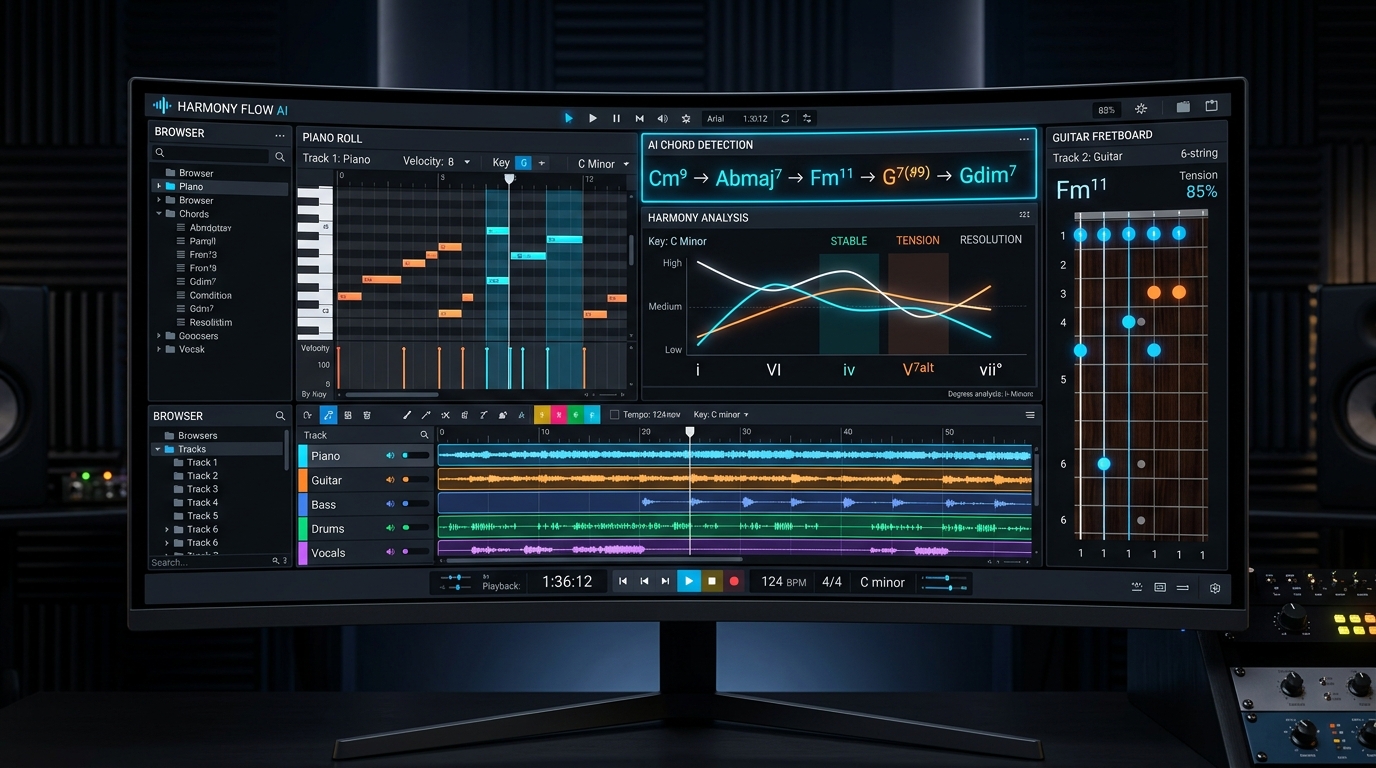
What Is a Free Chord AI Tool and Why Do You Need One in 2026?
A Free Chord AI tool is a software application or web-based platform that uses artificial intelligence to automatically detect, generate, or suggest musical chords from audio files, MIDI inputs, or even text prompts. In 2026, these tools have become indispensable for musicians, producers, songwriters, and hobbyists who lack formal music theory training but still want to create professional-sounding harmonies. Instead of spending hours manually identifying chord progressions or experimenting on a keyboard, you can upload a melody or hum a tune, and the AI instantly analyzes the pitch, key, and tempo to output the most accurate chords. This democratizes music creation, allowing anyone with a basic idea to build complex arrangements without needing a degree in composition. The value for free users is immense: you bypass the steep learning curve of traditional theory while retaining full creative control over your sound.
By 2026, the demand for Free Chord AI tools has surged due to the rise of bedroom producers, independent artists, and content creators who need quick, reliable harmonic analysis without subscription costs. These tools are now integrated into workflows for everything from pop songwriting to film scoring, and they support multiple genres including jazz, EDM, and classical. For example, a YouTuber creating background music for a video can use free software to ensure chord changes align with dramatic moments, or a beginner guitarist can input a recorded riff to discover the underlying progression. The best free options affordably bridge the gap between inspiration and execution, reducing the time from idea to full demo. However, free tiers often impose practical limits—such as restricted export quality, watermarking, or a cap on monthly analyses—which forces users to prioritize which projects warrant premium access.
Among the most generous free options, you will find Hooktheory offers a limited free tier where you can analyze short song segments and visualize chord progressions in an interactive keyboard, though full song uploads require a paid account. Similarly, Chord AI by Neural DSP provides a free web demo with basic chord detection for up to 30-second audio clips, but outputs include a subtle watermark and reduced polyphonic resolution. Another solid option is Chordify, which transcribes chords from YouTube URLs or uploaded files in real time, though the free version limits daily transcriptions to five and displays advertisements between analyses. Each of these tools offers a genuine entry point for learning chord theory and speeding up production, but they also set clear boundaries that encourage eventual upgrades for serious work.
What Can You Do for Free with Free Chord AI Tools?
With free Chord AI tools, you can accomplish a surprising amount of harmonic analysis and generation without spending a cent. For instance, you can upload a monophonic melody recorded on your phone—such as a simple whistle or hum—and have the tool suggest diatonic chords that fit the key, complete with inversions and voicings. This is invaluable for songwriters who have a vocal line but struggle to build a chord foundation. You can also paste a link to a popular track on YouTube and receive an instant chord chart for the first 30 to 60 seconds, allowing you to study how professional songs are structured. Some free tools even offer a basic MIDI export option, letting you drag those chords into a DAW like Ableton Live or FL Studio for further editing. Another practical use is real-time chord detection during live jamming: you can play a guitar riff into your computer’s microphone and see the suggested chords appear on screen, which helps you identify if you’re accidentally playing out-of-key notes. These capabilities make free tier tools ideal for learning, experimentation, and quick sketches.
However, free versions come with notable limitations. Watermarking is common: generated chord charts or audio exports often include an audible or visual watermark, such as a periodic beep over the output or a logo printed on the sheet music. Quotas are another friction point—you might be limited to three analyses per day or fifty per month, which can be frustrating if you’re working on multiple projects simultaneously. Model restrictions also apply: the AI may only analyze simple monophonic lines rather than complex polyphonic mixes, or it might only recognize major and minor chords while ignoring sevenths, ninths, or diminished variations. Speed is another factor—free tiers often prioritize other users, so your analysis might take 15–30 seconds instead of the near-instantaneous response paid subscribers get. To bypass these hurdles, you could schedule your analyses for non-peak hours, break long tracks into smaller chunks, or use the free tiers as a learning tool before committing to a paid plan for final production. Accepting these constraints as part of the free experience allows you to extract maximum value without frustration.
In real-world scenarios, the free tier often proves more than sufficient. Consider a high school music teacher who wants to quickly generate chord charts for a class project covering a popular song—they can use Chordify’s free daily limit to transcribe five songs, which is plenty for a week’s worth of lessons. Or a hobbyist producer making lo-fi beats on the weekend might never need more than basic major/minor chord suggestions, and the watermark on exports can be ignored if the final track is only for SoundCloud or personal enjoyment. Even a wedding guitarist learning a new cover can rely on Hooktheory’s free tier to analyze the first verse and chorus, then manually extend the progression by ear. In each case, the free tool serves its purpose without forcing a purchase, making it a viable long-term option for casual or educational use.
Key Features of Free Free Chord AI Tools
- Real-time Audio Analysis: Many free tools can listen to live audio from your microphone and detect chords within seconds, displaying them as you play. This is perfect for practicing musicians who want instant feedback on their improvisation or for correcting intonation issues during rehearsals. The latency is typically under 200 milliseconds for simple inputs, though it may degrade with complex polyphony.
- Chord Progression Visualization: Free tiers often provide interactive chord diagrams, piano rolls, or guitar fretboards that show you exactly where to place your fingers. Tools like Hooktheory’s Hoop component let you click on any chord to hear how it sounds, making it easy to experiment with substitutions or inversions. This visual feedback accelerates learning more than static sheet music.
- Key and Tempo Detection: Beyond individual chords, free AI tools automatically identify the key signature and BPM of your audio, which is crucial for creating harmonically coherent progressions. This metadata helps you understand why certain chords sound better than others and allows you to transpose the entire progression to a different key with one click, albeit often restricted to the free tier’s available keys (usually limited to C, G, D, A, and E major).
- MIDI and Sheet Music Export: Many free versions allow you to export the detected chords as a MIDI file or a simple PDF of the chord chart. While the export may add a watermark or limited resolution, you can still import the MIDI into any DAW to edit the rhythm or add arpeggios. This bridges the gap between analysis and production without needing advanced music notation software.
- Genre-Specific Presets: Some free tools include pre-trained models for different musical genres like pop, jazz, or folk, which adjust the chord detection algorithm to prioritize typical harmonic patterns. For example, a jazz preset might be more forgiving of extended chords, while a pop preset focuses on simple triads. These presets let you tailor the analysis to match your creative style without needing manual configuration.
- Community Sharing and Feedback: Many free tiers integrate with online communities where you can share your chord progressions, get feedback from other users, or even collaborate on projects. This social feature turns a solo learning tool into a collaborative ecosystem, which is especially valuable for beginners who benefit from peer review. However, free accounts often have limited uploads or reduced visibility in the community feed.
Who Should Use Free Free Chord AI AI Tools?
Free Chord AI tools are primarily designed for independent musicians, music educators, and hobbyists who want to explore harmony without financial commitment. The main audience includes bedroom producers who are just starting out and cannot justify a premium subscription, as well as songwriters who need occasional chord checks rather than daily intensive use. Music teachers also benefit greatly: they can demonstrate chord theory in real time to students, or quickly transcribe songs for classroom activities. Additionally, content creators—such as YouTubers or podcasters—who produce background music may use free tools to ensure their jingles are harmonically sound, especially if the watermark doesn’t appear in the final cut or is easily masked. Even professional musicians sometimes use free tiers for quick sketches before moving to more advanced software for final production, treating the free version as a fast prototyping tool.
For example, a singer-songwriter who composes by humming can use a free tool like Chordify to turn a 30-second vocal loop into a chord chart, then manually extend it into a full song structure. A high school band director can analyze five songs per day to create handouts for students learning pop repertoire. A freelance video editor can generate chord suggestions for a custom score without hiring a composer, saving time and money. In each case, the free tool provides enough utility to complete the task successfully, though the watermark or daily limit might prompt the user to consider a paid plan if the workflow becomes regular. Ultimately, free Chord AI tools are ideal for anyone who prioritizes accessibility and experimentation over polished, unlimited output.
Consider upgrading to a paid plan when you hit the free tier’s practical limits. If you find yourself analyzing more than five songs per day, needing high-quality exports without watermarks, or requiring extended chord types like diminished sevenths or augmented chords, then a monthly subscription becomes justifiable. Similarly, if you are releasing music commercially and cannot risk a watermark on your final masters, or if you need faster processing for time-sensitive projects, the paid tier will pay for itself in saved time and professionalism. For most occasional users, however, the free tier remains a powerful, no-cost companion for creative exploration.
Best Free AI Chord AI Tools & Software
Explore our curated selection of verified free chord solutions, offering generous free plans, freemium features, or zero-cost access.